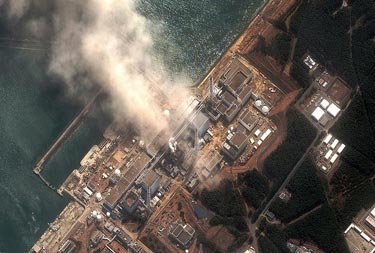
Recently, on March 11th, 2011, a massive earthquake hit Japan, registering at a magnitude of 8.9 on the Richter Scale (although officials later re-measured the quake, the new measurement being 9.0), causing an immense tsunami. In addition to causing a colossal number of deaths, a nuclear power plant at Fukushima exploded, and the emergency that it caused was rated a five on a seven-point scale as of March 24. The earthquake caused an interruption in the power supply for the water cooling system, which ran cold water over the fuel rods to cool them off. Due to the lack of a cooling system, the fueling rods overheated and the outer metal coating melted off. This caused chemicals to be released, and when they mixed with the water vapor in the surrounding air, hydrogen was created and it caused an explosion in the reactor buildings. Japanese officials then doused the reactors with seawater as an emergency cool-down. Although Japan is in a sticky situation, they are handling the emergency well, considering the conditions.
Although this event seems like a complete tragedy, it will help other countries rethink their strategies concerning nuclear power plants. It will help others figure out how to efficiently deal with problems concerning nuclear meltdowns and explosions. This is extremely important because if a meltdown does occur, it is vital to respond quickly and appropriately because letting nuclear radiation out of the reactors would affect the entire world. Radiation poisoning is extremely hazardous, so any information learned about how to deal with emergencies due to nuclear meltdowns is important.
Article Citation: Dacey, James. "Japan quake triggers nuclear rethink."
Environmental Research Web. IOP, 24 Mar. 2011. Web. 5 Apr. 2011.
<http://environmentalresearchweb.org/cws/article/news/45524>
